How Much Money Do You Need to Buy a Home in Utah in 2026?
By Dan Candidi ·
By Dan Candidi, Utah real estate agent | Lawson Real Estate Team at eXp Realty
You don't universally need 20% down to buy a home in Utah: some qualifying conventional loans start at 3%, FHA loans can start at 3.5%, and eligible VA or USDA borrowers may qualify for no down payment.
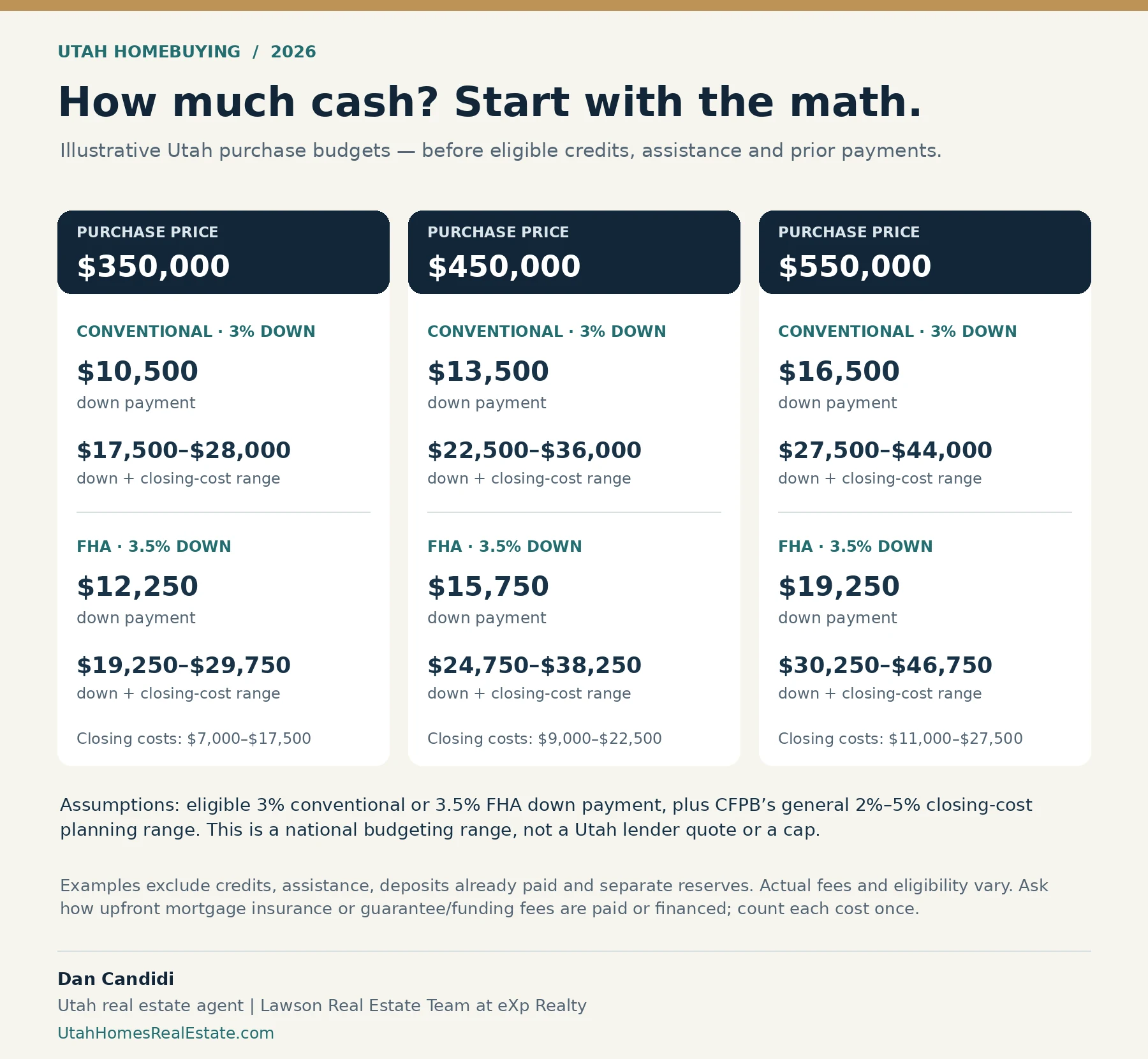
On a $450,000 home, a qualifying 3%-down conventional loan means $13,500 down; adding a general 2%–5% closing-cost planning range brings the illustration to roughly $22,500–$36,000 before subtracting eligible assistance, seller or lender credits, and deposits already paid. That's a budgeting illustration, not a lender quote or an estimate of what every Utah buyer will pay; budget separately for expenses and savings beyond closing.
A planning formula is: estimated cash to close = down payment + closing costs (including prepaids and initial escrow deposits) − eligible credits and assistance − earnest money and other transaction costs already paid, with adjustments for prorations and other settlement items. Count each item once: don't add prepaids again if they're already in your closing-cost total, or subtract a lender credit already included in that total. Keep separate savings for inspections and other expenses paid before closing, moving and unexpected repairs. Your lender's Loan Estimate and final Closing Disclosure show the transaction-specific figures.
Do you need 20% down to buy a house?
No. The 20%-down myth has certainly made itself comfortable. Twenty percent down can reduce the amount you borrow and may help you avoid private mortgage insurance on a conventional loan. But it's not a universal requirement. Fannie Mae's HomeReady and Freddie Mac's Home Possible, for example, offer qualifying buyers options with 3% down. HomeReady and Home Possible generally limit qualifying income to 80% of area median income and require a principal residence, along with other underwriting and education requirements where applicable. Your lender determines whether you qualify.
A smaller down payment leaves more cash in savings but usually increases the loan balance, and some mortgages require mortgage insurance or other fees. I'd compare the full monthly payment, what you'll keep in savings after closing, and how long you expect to own the home before deciding whether less down works for you.
How much down payment do different mortgage loans require?
Conventional: Some eligible 3%-down options are available, including Fannie Mae HomeReady and Freddie Mac Home Possible. Standard conventional terms vary by lender and loan type.
FHA: Eligible borrowers may qualify with as little as 3.5% down. Mortgage insurance and the borrower's qualification still affect total cost.
VA: Eligible veterans, active-duty service members and other qualifying borrowers may use a VA-backed purchase loan without a down payment, subject to entitlement, appraisal and lender requirements. If the purchase price exceeds the appraised value, additional cash may be needed. A VA funding fee may apply unless the borrower is exempt, and other closing costs still exist.
USDA: The Section 502 Guaranteed Loan Program can offer up to 100% financing to qualifying buyers purchasing an eligible home in an eligible rural area. Income, property, lender and program rules apply.
When you're comparing options, look beyond the down-payment percentage. The loan type, insurance, interest rate, HOA dues, property taxes and lender fees all affect whether the payment and upfront costs fit your budget.
What are closing costs in Utah?
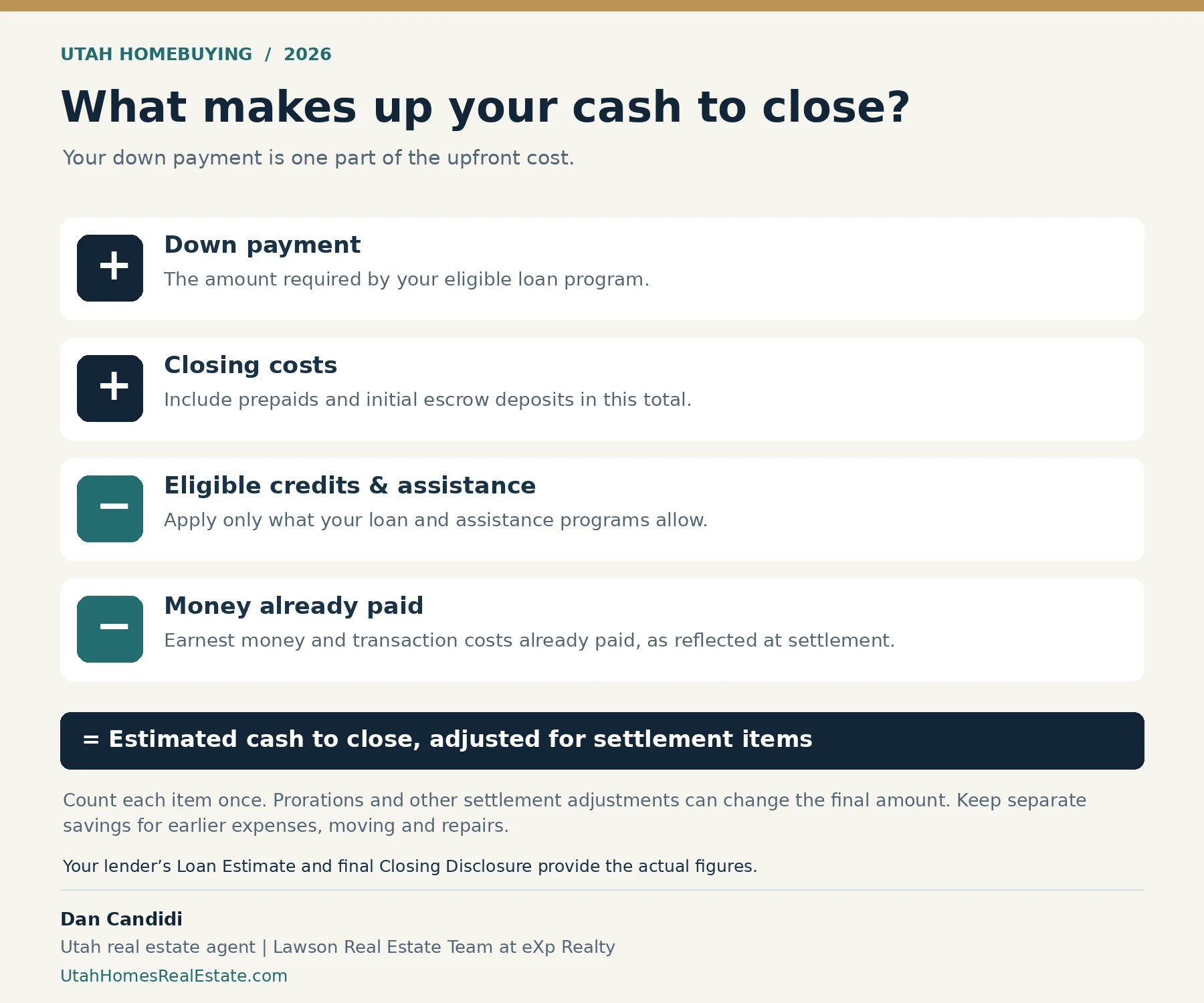
Closing costs are separate from the down payment. They may include lender origination or underwriting fees, an appraisal, title and settlement charges, recording costs, prepaid homeowners insurance, property taxes, escrow deposits and optional discount points. Some costs may be paid earlier instead of at the closing table.
The Consumer Financial Protection Bureau gives a broad budgeting range of about 2%–5% of the purchase price, not including the down payment. That's a national planning estimate, not a verified Utah-specific fee schedule. The amount on your actual Loan Estimate can be higher or lower depending on the lender, loan, property and timing.
What would you need for a $350,000, $450,000 or $550,000 Utah home?
These examples assume an eligible 3% conventional down payment OR 3.5% FHA down payment, plus a hypothetical 2%–5% closing-cost range. They exclude seller/lender credits, assistance and deposits already paid; they also exclude separate emergency savings. They are not current home-price medians or loan offers. The closing-cost allowance is not an itemized fee quote or a cap: ask how any upfront mortgage insurance or guarantee/funding fee is paid or financed, and don't count it twice.
Conventional loan example — 3% down
Leave room in your budget for a home inspection, moving costs and a reserve for maintenance. For most purchase mortgages, a lender must provide a Loan Estimate within three business days after receiving the six required pieces of application information, including a property address. You don't need a signed purchase contract to request one.
What were home prices in Salt Lake County and Utah County in 2026?
Your purchase price and down-payment percentage both affect the dollars you'll need. For local context, the table below uses the saved October 19, 2026 WFRMLS research snapshot for Q3 homes marked as non-new-construction. These are past closed transactions from July 1 through September 30, 2026, not homes for sale today.
| Property type | Salt Lake County median sold price (n) | Utah County median sold price (n) |
|---|---|---|
| Single-family residence | $640,000 (2,044) | $605,000 (1,415) |
| Townhouse | $445,950 (472) | $415,000 (426) |
| Condominium | $345,000 (335) | $309,950 (188) |
MLS data source: UtahRealEstate.com (WFRMLS). Analysis and interpretation: Dan Candidi. Saved extraction and audit dated October 19, 2026. Filters: Closed residential listings; CloseDate July 1–September 30, 2026 inclusive; counties as labeled; NewConstructionYN=false; exact Single Family Residence, Townhouse and Condominium subtypes. Counts are unique MLS listing IDs, not unique parcels; Twin and other subtypes are excluded. The non-new-construction flag does not prove prior occupancy. The saved audit reproduced these figures on the same feed; RapidStats' all-construction charts are a different population.
If your goal is to keep the purchase price and initial down payment lower, compare townhomes and condos with single-family homes. I'd be careful with the word 'bargain' until you've compared the full costs. Check HOA dues, financing eligibility, maintenance responsibilities, insurance and any restrictions tied to the specific property.
Are there down-payment assistance programs in Utah?
Yes, but 'assistance' doesn't always mean free money. Utah Housing Corporation publishes several programs that can help eligible buyers with upfront costs through participating lenders. The programs below are different loans with different repayment rules. Eligibility, lender approval and current program availability must all be confirmed.
Utah Housing traditional down-payment assistance
Under Utah Housing's July 6, 2026 program matrix, eligible buyers using an eligible Utah Housing first mortgage may qualify for a traditional second mortgage of up to 6% of the first loan amount, capped at $27,500. This is a repayable 30-year amortizing second mortgage with a monthly payment. The matrix sets the second-mortgage interest calculation relative to the first loan, subject to limits. Ask your lender for the actual terms; don't treat this as a grant.
Utah Housing deferred down-payment assistance
The same program matrix also lists a deferred second mortgage of up to 3.5% of the first mortgage amount, capped at $27,500. It accrues 3.5% simple interest, has no monthly payment, and generally becomes due at maturity, sale or refinance. Deferred is not the same thing as forgiven.
The separate $20,000 first-time buyer new-construction program
Under Utah Housing's February 23, 2026 program matrix, eligible first-time buyers may qualify for a separate 0%-interest loan of up to $20,000 toward approved down payment, closing costs or a permanent interest-rate reduction when purchasing an eligible newly constructed, never-occupied Utah home priced at $450,000 or less. The published rules include a three-year principal-residence nonownership test with stated exceptions, at least 12 consecutive months of Utah residency before closing, and a qualifying Utah Housing first mortgage through an approved participating lender. Income, credit and owner-occupancy requirements apply.
This is a loan secured by the property, not a grant. Under the published terms, it has no monthly payment, but repayment conditions apply, including conditions related to selling or refinancing. Review current Utah Housing terms and your loan documents with a participating lender before relying on the assistance. Combining assistance programs may also require lender and program approval.
Funding check as of October 20, 2026: UHC's published FAQ describes limited program funding, but a current dated balance and the ability to reserve funds for a new purchase have not been independently confirmed. Do not rely on the $20,000 as available for your purchase until UHC or a participating lender verifies it.
Can seller credits, lender credits and earnest money lower cash to close?
They can change how much you need to bring on closing day, but each works differently.
Seller credits: A seller may agree to help pay certain eligible buyer closing costs, subject to your loan's limits and contract terms. Seller closing-cost credits generally cannot fund your required down payment.
Lender credits: A lender may offer a credit toward some closing costs, often in exchange for a different interest-rate tradeoff. Ask to compare the total cost over the time you expect to have the loan.
Earnest money: This is a deposit paid according to the amount, timing and delivery terms in your purchase contract. If it is credited toward your purchase at closing, it reduces the remaining amount you must bring then; it doesn't mean you paid the same cost twice. Refund rights depend on your contract and what happens during the transaction.
Approved assistance: A grant or assistance loan can reduce some money you need upfront if the particular program and your first mortgage allow it. Some assistance creates another debt, so include its payments and repayment terms in your budget.
What should you budget beyond the closing table?
Make room for inspection costs, moving expenses, immediate repairs, utility setup, HOA initiation or transfer charges where applicable, and a cash cushion. Review any buyer-broker compensation you may owe under your signed agreement and how it will be paid; don't assume another party will cover it. Avoid counting fees twice if they're already in your closing-cost estimate. If a condo seems affordable because of its lower median sold price, make sure the HOA dues and master-insurance situation still fit the monthly budget. If a detached home needs a roof or major mechanical work, keeping money after closing can be more important than maximizing your down payment.
How do you get a realistic cash-to-close estimate for a Utah home?
Start with a price range, how much of your savings you want to put toward the purchase, and a monthly payment you're comfortable with. Then compare Loan Estimates from lenders. Ask what changes with a different down payment, property type or credit strategy.
A useful estimate should clearly show your down payment, loan costs, prepaid taxes/insurance, any buyer costs due earlier, seller or lender credits, approved assistance and deposits already made. Build your total housing budget from principal, interest, property taxes, insurance, any mortgage insurance and any assistance-loan payment. Add HOA dues and other costs paid separately; they may not be included in the lender's quoted monthly payment.
If you've got a price range in mind, I can help you compare what these numbers look like for a single-family home, townhome or condo in Salt Lake County or Utah County. Send me your range and the monthly payment you're comfortable with. I'll help with the real estate comparison; your lender confirms mortgage eligibility and loan terms. We'll start with the budget; the kitchen photos can wait a minute.
Frequently asked questions
Can I buy a home in Utah with $10,000 saved?
Possibly, but don't assume it. Your price range, loan approval, actual closing costs and any eligible assistance or credits will determine whether $10,000 is enough. You should also consider what savings would remain after closing.
Is 20% down required for a first-time buyer?
No. Some eligible conventional loans allow 3% down, FHA can allow 3.5%, and eligible VA or USDA borrowers may have no-down-payment options. These programs have different requirements and costs.
Does zero down mean I can buy a house with no money?
Not necessarily. Even if the down payment is zero, there may be lender and title charges, prepaid taxes/insurance, inspections and other expenses. Available credits or assistance can change the final amount.
Does earnest money count toward my down payment?
Generally, earnest money credited at settlement can help cover the funds due for the transaction, including amounts otherwise needed at closing. Whether it can be refunded before closing depends on the signed contract and applicable conditions.
Can the seller pay my closing costs?
A seller can sometimes agree to contribute toward eligible closing costs. Loan-program limits and negotiations determine what is allowed. Seller closing-cost credits generally cannot fund your required down payment.
Is Utah's $20,000 first-time buyer assistance free money?
No. The special program described here is a 0%-interest assistance loan with specific qualification and repayment rules for eligible new-construction purchases. Its funding status should be confirmed with Utah Housing or a participating lender before relying on it.
Important information
Market data is sourced from UtahRealEstate.com (WFRMLS). The observations, interpretations and opinions expressed in this article are my own and do not necessarily reflect the views of eXp Realty or Lawson Real Estate Team.
This article is for general educational purposes, not personalized financial, mortgage, tax, or legal advice. Loan terms, closing costs, eligibility, and assistance availability can change and depend on your circumstances. Before making a decision, confirm current details and request a Loan Estimate from a qualified mortgage lender; consult an attorney, tax professional, or financial adviser when appropriate.